

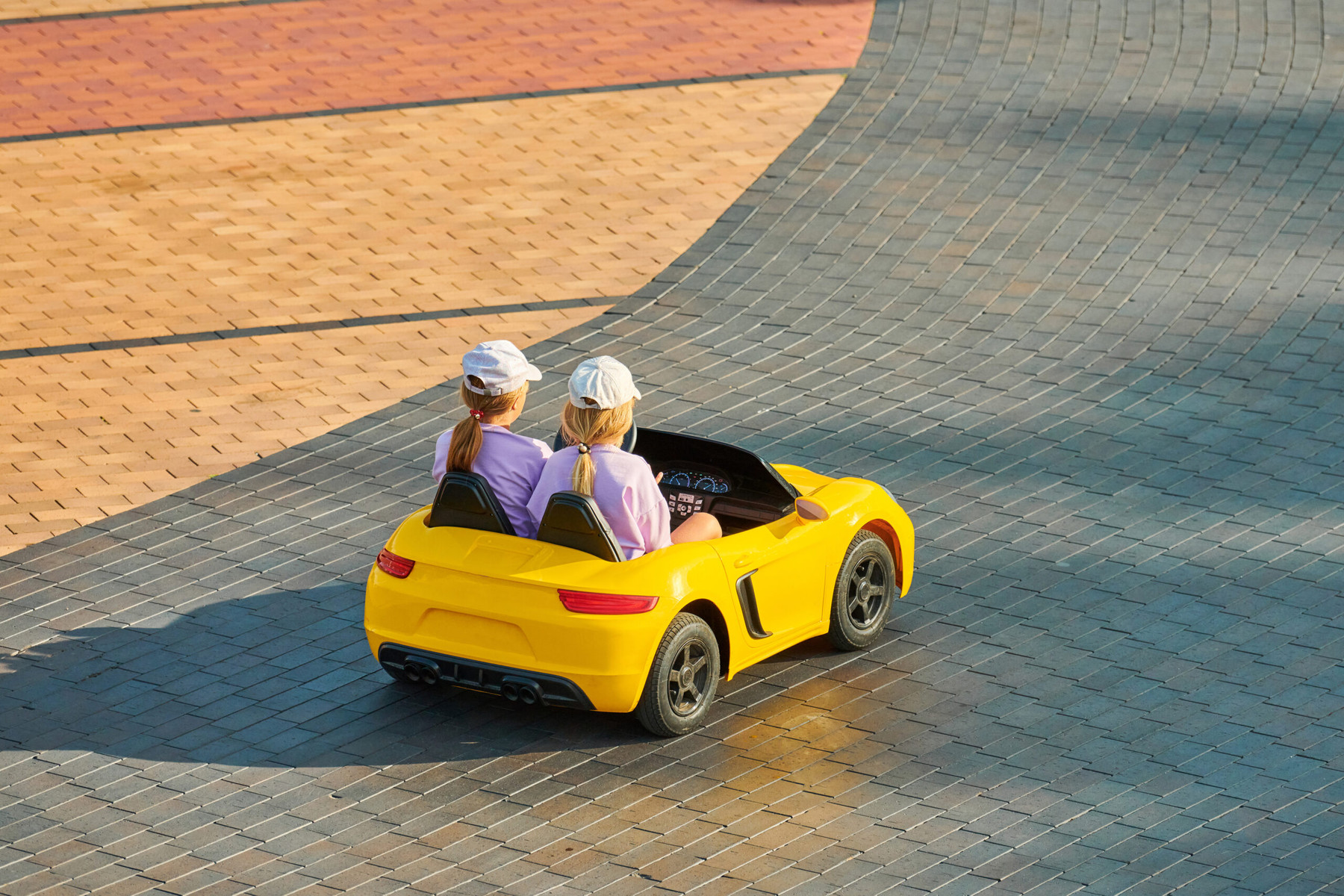
A children's electric car can be not only a fun toy, but also a great way to teach safe driving skills. Little ones quickly figure out how the “gas and brake” work, but more importantly—when to use them and why. The game allows them to make mistakes safely, practice, and receive feedback without stress, making it easier to remember the rules. Below you’ll find an expanded program with 7 simple yet highly effective games that develop attention, reaction time, courtesy on the road, and responsibility for their “vehicle.” You can adapt each game to the children’s age, available space, and electric car model. The most important thing is to keep the sessions short and fun, with clear rules and plenty of praise for good decisions.
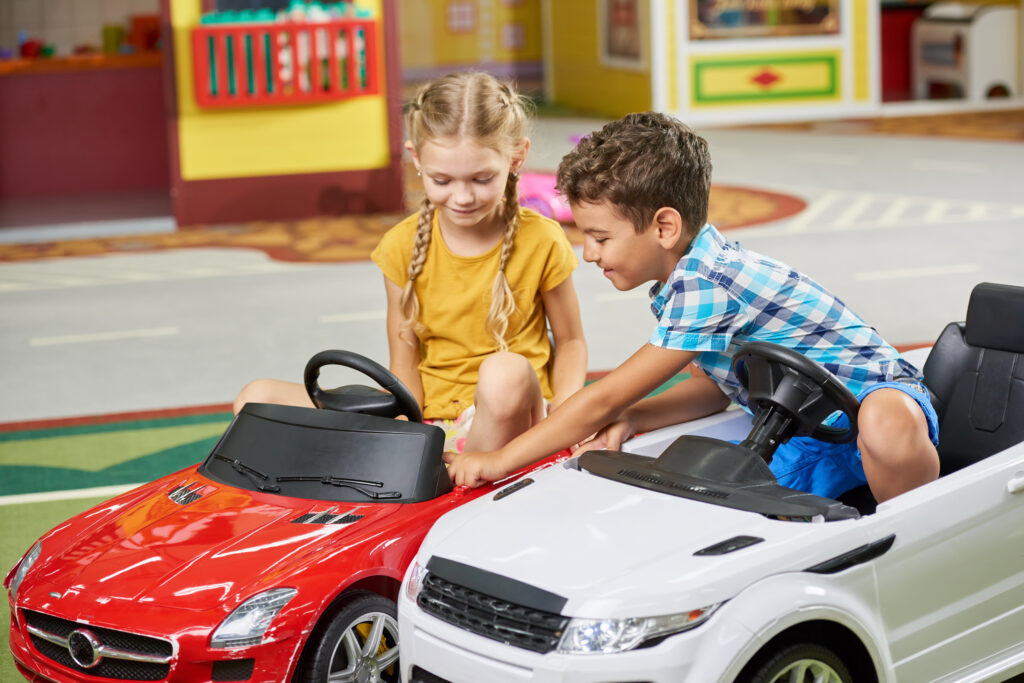
Safety First
An adult is always present to supervise.The adult’s role is not only to watch but also to act as an “instructor”: to show signs, give signals, remind players of the word “STOP,” and help resolve conflicts between players.
Location.Play in an enclosed, safe area—such as a yard, gym, playground, or large garage. Avoid public roads, hills, and areas where real cars or bicycles might appear. If the surface is uneven, reduce your speed and keep a safe distance.
Speed and control.Switch to a slower mode. If the electric car has a remote control, an adult should hold onto it—it serves as a “safety brake” in case the child fails to react in time.
Safety.Always fasten your seatbelts. A helmet is highly recommended, especially for younger children or when playing on uneven, paved surfaces.
The STOP Rule.Agree in advance on the word “STOP”: when everyone hears it, they must stop immediately. Practice stopping on command before starting any game.
Clear boundaries.Use chalk, tape, or cones to mark the course, dangerous areas (“red zones”), and parking spots. It’s easier for a child to stay safe when the boundaries are visible.
What will you need?
- A fewconesor water bottles (you can fill them with sand to keep them from tipping over).
- Chalkortapefor marking the course.
- Mini road signs(you can make them out of cardboard): "Stop," speed limit, crosswalk, one-way street, parking zone.
- Traffic light cards: red, yellow, green.
- Stopwatch(on your phone).
- Stickersor badges – "for merit".
- In addition:a checklistfor the technical inspection,a scorecard, andaprinted“game passport”with space for stars.
Tip: Keep all your game components in a single box—that way, it will be easy to quickly set up and put away the games.
1) Traffic light
Objective:To learn to follow signals and stop in time.
Age:2.5–6 years
Preparation.Mark the starting line. An adult holds up three colored cards or stands in the “traffic light” position.
Rules.
Green – go; yellow – slow down and prepare to stop; red – stop at the line (wheels must not cross the line).
What they learn:Reaction times, situational awareness, and braking distance.
Progression.
Level 1: Slow, clear signals.
Level 2: Shorter "waves" of green intervals.
Level 3: Insert an unexpected yellow light or a three-color sequence to encourage the child to plan ahead.
Common mistakes.The child “drags” the front wheel across the line—show them how to stop just before the line. Give them a star for a “clean” stop.
Bonus: One sticker for every "clean" stop. 5 stickers = "Traffic Light Master".
2) Crosswalk
Objective:To politely let pedestrians cross.
Age:3–7 years
Preparation.Draw a "zebra crossing." One child plays the driver, and another plays the pedestrian (or the parents).
Rules.
When a pedestrian raises their hand, it is a signal that they intend to cross. The driver slows down and stops before the crosswalk, lets the pedestrian cross, checks both directions, and only then proceeds.
What they learn:right-of-way rules, empathy, and the importance of eye contact (“Look at the pedestrian—can they see you?”).
Progression.
– At the beginning – one pedestrian and clear signals.
– Later – two pedestrians approaching from different directions.
– At the end – a pedestrian turning across the crosswalk (the driver must remain stopped).
Additionally:Switch roles every 2 minutes. The pedestrian can wear a "safety vest"—this helps illustrate the importance of visibility.
3) Court attendant
Goal:to park neatly and safely.
Age:4–8 years
Preparation.Use the cones or tape to set up 2–3 parking spots: parallel, "nose forward," and "reverse."
Rules.
Drive in neatly, without knocking over the cones, and stop in the center. If the model allows it, back out while glancing over your shoulder (we’re practicing our field of vision).
What they learn:steering, controlling the steering wheel and pedals, and focusing their gaze (“Where you look, the car goes”).
Progression.
– "Flawless": who can park the car perfectly the fastest.
– "In One Go": as few corrective maneuvers as possible.
– "Tight Spot": gradually reduce the distance between the cones.
Additionally: One point for every "clean" entry. 5 points = "Parking Master Badge".
4) “Safe distance”
Objective:Maintain a safe distance from the car in front.
Age:3–7 years
Setup.One electric car is the “leader,” the other is the “follower.” Mark the area between them with two cones to indicate “no entry.”
Rules.
The follower rides behind the leader in such a way that they never enter the "red zone." The leader changes speed gradually, without sudden bursts of full throttle.
What they learn:speed control, spatial awareness, and concentration.
Progression.
– Slower pace and wide area.
– Next – narrower area, turns, “slalom.”
– You can add an unexpected stop by the leader – the follower must anticipate this and start slowing down earlier.
Additionally: Apply the "two-cone rule"—if the follower can see both cones, the distance is safe.
5) Route of road signs
Objective:To recognize basic road signs and follow them.
Age:4–8 years
Setup.Place 4–5 signs: “Stop,” “Speed Limit 5,” “One-Way,” “U-Turn,” and “Parking.” Arrange them along the route in a logical order.
Rules.
The child follows the route and follows the signs: stops at "Stop," slows down to "Speed 5," does not enter the oncoming lane, turns around, and parks the electric car in the parking space.
What they learn:the meanings of signs, route planning, and anticipation.
Progression.
– At the beginning – one sign at a time.
– Later – “combinations” (e.g., “Stop” + “One-way” + “No Parking”).
– At the end – the child sets up the signs themselves and explains their meaning (metacognition).
Additionally: One point for a correct action. Collect 5 points to earn a “Traffic Star.” If the child makes a mistake, go back to the sign and explain it again, without any penalties.
6) Technical inspection
Goal:Establish a pre-trip routine.
Age:2.5–6 years
Preparation.Make a checklist: seat belts, tires, lights, horn, battery charge, seat position.
Rules.
For each item, the child presses the check button (or checks it off the list) and says “OK” out loud. Only then does the child sit down, fasten the seatbelt, and start moving.
What they learn:responsibility, consistency, and safety procedures (just like pilots or drivers in real life).
Progression.
– At the beginning – 3 points.
– Later – add another 2–3 points until the list becomes “automatic.”
– At the end – the child conducts the “inspection” of the other players on their own.
Additionally:Present the "Master's Badge"—print a card with the child's name and space for stamps to indicate self-assessment.
7) Eco-Driver
Goal:Ride smoothly and conserve battery power.
Age:5–8 years
Preparation.Mark out a short circuit with 3 checkpoints. Set the rule: no "full" acceleration presses.
Rules.
Start gently, maintain a steady speed, release the accelerator before coming to a stop, and let the electric vehicle coast, applying the brakes only at the very end.
What it learns:energy planning, trajectory smoothness, and forecasting (when to start slowing down).
Progression.
– Compare who can complete more laps on a single charge.
– Add the “smooth steering” challenge: make as few sharp turns as possible.
– Set the “cruise” challenge: maintain the same speed for the entire stretch.
Additionally: At the end of each lap, the child reflects: “Where did I start to slow down? Were there any sudden stops?” This fosters self-reflection.
How can I motivate my child?
Game Passport.Create a “driver’s passport” with 7 game icons. Stick a star on it after each exercise. A symbolic prize awaits you for a full passport (a sheet of stickers, a chosen route, or the right to “set the rules” next time).
Role-playing games.Let your child play the role of a “police officer,” “rescue worker,” or “ambulance driver.” Role-playing helps you naturally talk about responsibilities and providing assistance on the road. The “officer” can check the vehicle’s condition, and the “rescuer” can check if the crosswalk is clear.
Short rounds.Ideal duration: 5–10 minutes of play + a 2-minute break. Three short rounds are better than one long one—this helps maintain focus.
Positive feedback.Give specific praise: “I really liked how you stopped before the crosswalk” or “You did a great job slowing down before the light turned yellow.” This helps the child understand what they did right and encourages them to repeat it.
Clear goals.Announce one “rule of the day” for each session (e.g., “Today’s focus is on a clean stop”). The goal must be clear and measurable.
Game adaptations by age and setting
- Ages 2.5–4.More visual aids (large cards), fewer signs at a time, longer “green” intervals. Recommended: “Traffic Lights” and “Vehicle Inspection.”
- Ages 5–6.You can combine the games into a sequence: “Vehicle Inspection” → “Traffic Lights” → “Crosswalk.” Introduce a point system.
- Ages 7–8.Add route planning: the child places the markers themselves and explains the plan. A timer, “one-shot” tasks, and energy-saving challenges.
- A small space (room).Shorter laps, more "stopping" tasks, and sign recognition at "stops."
- A larger court (outdoors).Longer sequences, "chase" games, combinations of turns.
Common Mistakes and How to Avoid Them
If the course is too difficult at first →start with 1–2 tasks and let them experience success quickly. Success is motivating.
If the pace is too fast →choose a slower one until the child gets the hang of it. Increase the speed only once “clean” stops and distances have become second nature.
No boundaries →mark the “red zones” and the “safe zone.” Pictures speak louder than words—this works better for children.
Vague feedback →Give specific praise immediately after the action. Avoid vague comments like “good”—specify what was good.
Just “penalties” for mistakes →mistakes are part of learning. It’s better to “go back to the beginning and try again” than to give a “mark down.” Stars for effort work better than stars for perfection.
Sessions that are too long →Stick to 5–10-minute sessions with breaks. When a child gets tired, mistakes increase and motivation decreases.
For Parents: A Framework That Works
- Pre-start ritual (2 min.)– "Technical inspection" + review of STOP rules.
- Rule of the Day (1 sentence)– “Today we’re learning how to stop cleanly.”
- Two or three games (10–15 min.)– short, straightforward, and progressive.
- A star or a stamp– for a specific achievement.
- Brief reflection (1 min.)– “What went best? What would you like to try next time?”
Sample 20–25-minute lesson plan
- 2 min.Technical inspection (belts, wheels, battery charge, horn).
- 6 min."Traffic Light" (slow intervals at the beginning, an unexpected yellow light at the end).
- 6 min."Crosswalk" (one pedestrian → two pedestrians).
- 6 min.“Parking Master” (one parking spot → two; “in one go”).
- 1 min.Stars and a brief reflection.
Summary
- Games should befun and short, with clear visuals and a single key rule.
- Each activity helps developspecific skills: stopping, maintaining a safe distance, courtesy toward pedestrians, route planning, technical responsibility, and smooth riding.
- Positive feedbackand the game pass help maintain motivation, whilethe STOP rule, slow mode, and clear boundaries ensure safety.
- The most important thing isto reinforce good habits: praise them for stopping, looking out for pedestrians, starting slowly, and slowing down in advance when approaching an obstacle.
By using these 7 games and a clear structure, you’ll turn a children’s electric car into not only a fun adventure but also a practical “traffic school” where the rules are learned naturally—through play—and you can always choose a children’s electric car from us— mukutis.lt